


Combining E-Ink with IoT: Non-volatile Displays for Smart Home and Office
by Josh Biggs in Tech on 9th September 2025Technology has reached a point where even the smallest details in our surroundings are becoming intelligent. Smart thermostats, connected lighting, energy meters, and digital assistants are only a fraction of what modern homes and offices already use daily. But in this connected environment, one overlooked element is the display — the silent interface that communicates data without distraction. Traditional LCDs and OLED screens are energy-intensive and prone to burnout, which makes them less ideal for devices meant to run continuously. This is where electronic ink, or E-Ink, demonstrates its unique strength when combined with the Internet of Things (IoT). The partnership between low-power displays and always-connected devices is quietly reshaping how we read, monitor, and interact with information around us.
Why E-Ink fits the IoT ecosystem
E-Ink technology has always been praised for its non-volatile nature — it holds an image without drawing additional power once the pixels are set. In contrast to traditional screens that refresh constantly, an E-Ink display consumes energy only when the content changes. This makes it perfectly suited for IoT devices that prioritize efficiency, longevity, and clear visibility in diverse lighting conditions.
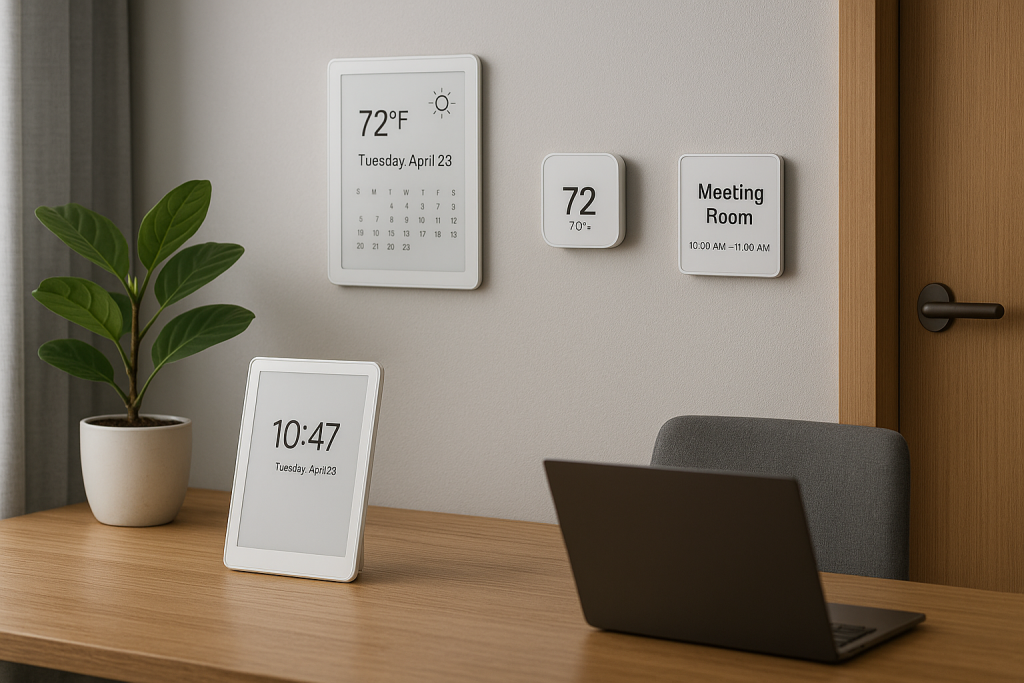
Imagine a smart fridge panel showing the shopping list, a kitchen scale displaying nutritional data, or a meeting room door label that updates when a new reservation is made. None of these require constant refresh cycles, yet they demand clarity and reliability. E-Ink offers both, making it an elegant bridge between digital systems and human perception. Even devices such as the BOOX GO 6 white demonstrate how refined an E-Ink interface can look and feel, setting a precedent for how displays can complement IoT functionality without unnecessary complexity.
Power efficiency and sustainability
Smart devices are multiplying in homes and offices, raising concerns about energy consumption. Each new connected gadget requires power, and collectively they contribute to electricity usage that cannot be ignored. By employing non-volatile E-Ink displays, device manufacturers reduce one of the largest drains — the display itself.
A sensor hub with an E-Ink screen can run for months or even years on a coin-cell battery, making it feasible to deploy displays in places where frequent charging or wiring would be impractical. Think about remote sensors for indoor air quality or office occupancy trackers mounted on walls. The minimal energy draw means fewer replacements, less waste, and a more sustainable approach to smart living and working environments.
A new layer of communication in smart homes
The appeal of a connected home lies not only in automation but also in communication. E-Ink can play a vital role here by providing clear, static, and legible information points across the house. A weather station in the hallway, a family calendar by the fridge, or a simple energy usage display next to the power box — all these benefit from a screen that doesn’t shine in your face but delivers critical information with calm precision.
One of the reasons E-Ink feels so natural in this context is its paper-like quality. Instead of glowing at you, it reflects ambient light, just like printed text. This allows information to blend into the environment without becoming intrusive. A smart home should support comfort, not overload attention. Non-volatile displays help maintain that balance.
IoT in the modern office with E-Ink
In offices, communication is everything. Meeting room schedules, desk reservations, visitor information, and office-wide announcements are often scattered across different platforms. Having non-volatile E-Ink displays integrated into IoT systems allows these details to appear in real-time, directly in the physical environment.
An office door sign that updates automatically with new bookings is more than a convenience — it eliminates friction. Employees no longer need to check apps or dashboards; the information is right there, accurate and constantly updated. When tied to IoT backbones, such as building management systems, E-Ink displays become living noticeboards that keep everyone synchronized without consuming energy unnecessarily.
This is also where services like Einktab come into the picture. By aligning E-Ink technology with IoT platforms, developers can build scalable solutions for both homes and workplaces. Instead of thinking of E-Ink as a niche display medium, it becomes a foundational element of how data is shared within connected environments.
Durability and design opportunities
Another strength of E-Ink lies in durability. Unlike glass-heavy LCDs or OLEDs, E-Ink displays can be made flexible, thin, and resistant to glare or sunlight. In an IoT setting, this opens creative possibilities — from e-labels on smart shelves in retail stores to digital price tags in cafeterias or cafeteria boards showing today’s menu. Each display holds information without draining power, updating only when necessary.
In design terms, the neutrality of E-Ink is also valuable. It doesn’t clash with architectural styles or distract with excessive brightness. Whether mounted in a minimalist office corridor or integrated into the wooden walls of a smart cabin, the display feels functional yet refined. When the IoT is about connecting invisible processes with visible outcomes, E-Ink proves to be a near-ideal medium.
The quiet shift toward context-aware environments
What truly makes the combination of E-Ink and IoT powerful is context. Displays don’t just show data; they show the right data at the right moment. IoT ensures connectivity and intelligence, while E-Ink provides a sustainable surface for presenting that intelligence. A thermostat screen that only changes when the temperature shifts, a package delivery notice on your smart mailbox, or a public transportation timetable that refreshes once per update cycle — all are made possible with this synergy.
And unlike glowing displays that encourage distraction, E-Ink’s calm presence encourages focused interaction. You read the message, absorb it, and move on, without getting trapped in notifications or alerts.
Looking ahead
The path forward suggests even greater integration between IoT systems and non-volatile displays. As smart homes and offices continue to expand, the demand for durable, low-energy, and context-sensitive information delivery will grow. E-Ink’s evolution toward color, faster refresh rates, and flexible surfaces will only strengthen its role in this equation.
We are moving into an era where intelligence is ambient and unobtrusive. Displays will not dominate attention but serve quietly, informing us when needed and fading into the background when not. Combining IoT with E-Ink ensures that this future is not only smart but also sustainable and human-friendly.